

Inline Pickling Bath Monitoring
Introduction
Pickling baths are used downstream of the hot rolling process, but also in many other fields of the metal-working industry to remove, modify, passivate or clean surfaces in a defined manner. To this end, pickling solutions are employed, mainly consisting of mineral acids, like hydrochloric acid.
The concentration of these acids decreases during the pickling process, whereas the degree of disturbing components such as contaminations and carry-over increases.
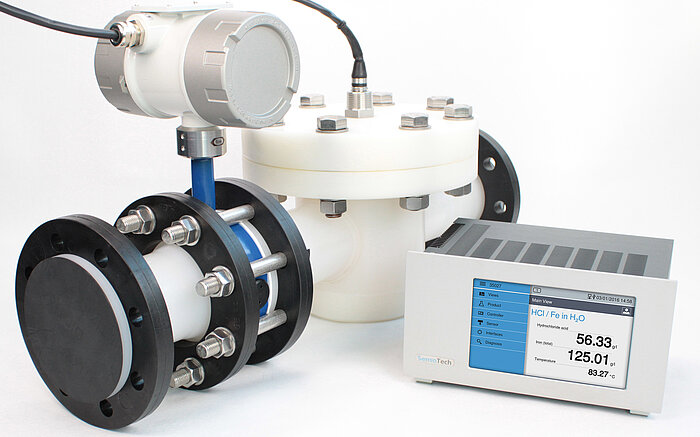
For the measurement of tertiary mixtures, it is possible to calculate a further measurand in addition to the sonic velocity sensor. Thus, the individual components such as acid and metal salts can be determined separately by the LiquiSonic® system.
LiquiSonic® controller view during inline pickling bath monitoring.
Monitoring of acid concentration and salinity
Both measuring signals are sent to the LiquiSonic® controller. The controller evaluates the information within seconds and shows the concentration of the acid and the salts separately on the display. This clear determination of both concentrations enables efficient process control. Influences of the salts are now not reflected in the measurement of the acid concentration.

Application
Pickling removes impurities from the steel surface. However, the acid also attacks the iron oxide on the metal surface and ferrous salts are generated (e.g. iron (II)). It is therefore of great importance to precisely control all process-relevant parameters, such as dwell time, bath temperature and bath composition. Only in this way, pickling bathes can be operated in an economic and resource-saving manner.
The measuring system LiquiSonic® allows the parallel detection of two physical measurands, such as sonic velocity and conductivity, and therefore the determination of the HCl concentration in the pickling bath as well as the iron content. This leads to the elimination of expensive laboratory analysis.
The inline LiquiSonic® sensors enable the user to monitor the process concentrations precise in real time. Fluctuations can be seen and corrected immediately and very flexibly.
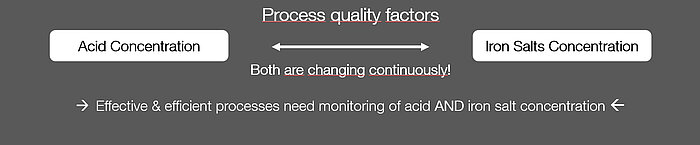
Process quality factors
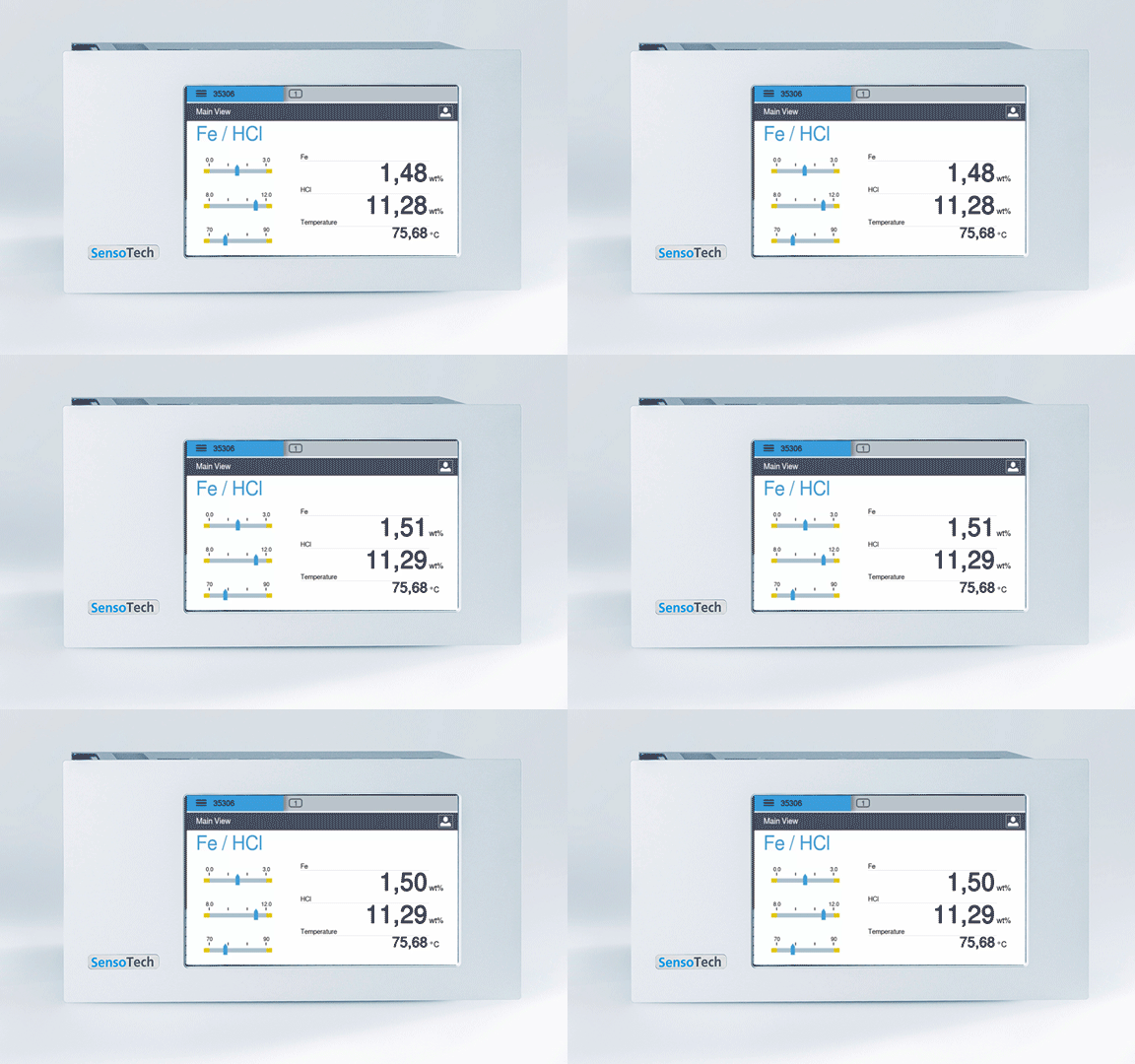
Measurement results of the pickling bath concentration with LiquiSonic®
Condition of Pickling Bath is known
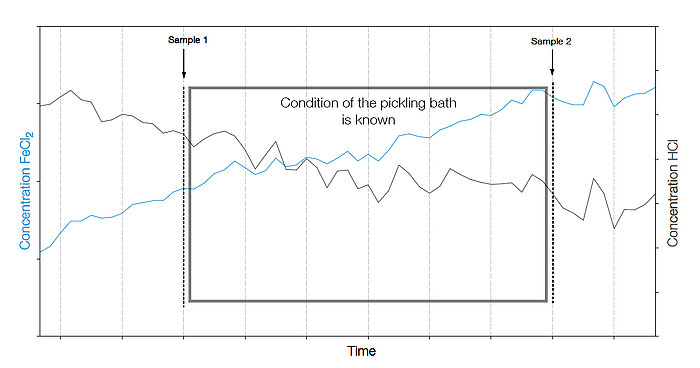
Measurement results of the pickling bath concentration with LiquiSonic®
Measurements are not taken punctually, as in the case of sampling, but at one-second intervals over the entire course of the process. This means that there is no time lag between the measurement and the result. Deviations can be reacted to very quickly, e.g. in the form of subsequent dosing. In addition to saving time, inline measurement has another advantage: the influence of human error is reduced to a minimum, since measured values only have to be read from the display. The dosing of hydrochloric acid is more accurate and thus more efficient. This reduces acid consumption, which in turn reduces costs. Multiple sampling and waiting for measurement results of the pickling bath concentration are a thing of the past.
Condition of Pickling Bath is unknown

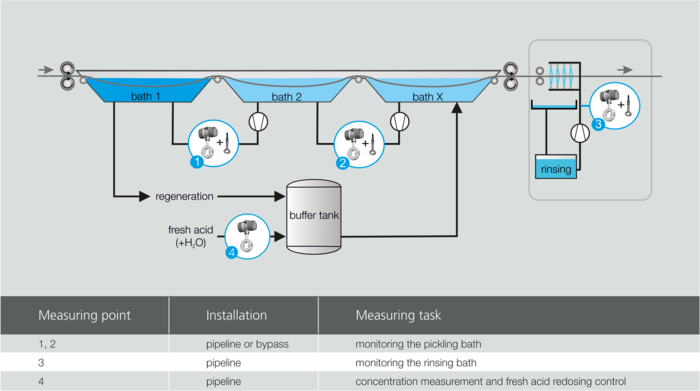
Installation of LiquiSonic® technology in the pickling bath process
The LiquiSonic® analyzer is installed into the transport pipelines (mostly DN80, 3“) or the bypass of the pickling bath. Even for installation either in the transport line of the rinsing bath or in the fresh acid feed, SensoTech offers proven solutions for decades.
The robust sensor construction and the optional special materials, like Halar or PFA, ensure long process life. The installation of the LiquiSonic® flange type sensor DN80 and the corresponding conductivity sensor in a piping system DN80 is simplified through the use of the installation adapter DN80. The total length of the measuring distance can be shortened by the adapter, to 0.70 m.
Typical measuring range:
concentration of free HCl: 0 - 120 g/l; 180 - 250 g/l
concentration range of Fe: 20 - 140 g/l
temperature range: 60 - 95 °C (140 - 200 °F)
Customer value
The LiquiSonic® analyzer provides a precise inline bath concentration measurement with real-time monitoring and continuous data logging. This allows the process to be automatically controlled in the optimal concentration range with stable, sufficient pickling results. LiquiSonic® is used to avoid a underdosage or overdosage of HCl. The analyzer reduces extensive lab measurements and replaces the time-consuming sampling process:
- time saving: 1 h per day
LiquiSonic® saves costs by reduction of hydrochloric acid consumption.
