

Alkylation
While sulfuric acid alkylation scores in safety and environmental protection issues, hydrofluoric acid alkylation is more efficient in acid recycling.
In frost, the aircraft, runway and pavement must be kept free of snow and ice before the start. Aircraft deicing reduces the aircraft weight and prevents unfavorable aerodynamics, which is reflected in a price reduction and ensures high standards of quality and safety. At special deicing areas of the airfield, the ADL (aircraft deicing liquid) is sprayed on the aircraft. ADL is a mixture of propylene glycol or ethylene glycol with water and is used at temperatures up to below -25°C.
For a better surface adhesion on the aircraft, the deicing liquid is additionally mixed with thickeners. Thereby, the deicing liquid works as a protection against refreezing. Depending on the type of aircraft and the weather conditions, different types and concentrations of ADL are used.
LiquiSonic® Concentration determination of sulfuric acid, water and butanol

Introduction
The robust LiquiSonic® measuring technique is setting benchmarks in the three-component analysis for years. Even under rough conditions corrosion, erosion and drift can be avoided by the use of special materials.
Application
The most important requirement on alkylation units is the failure-free operation, even if there are unsteady raw material compositions or secondary components.
The concentration of acid soluble oil has to be hold on a minimum level to avoid an acid run-away. To control the acid, water and ASO-concentration it´s essential to avoid this economic worst-case. Common sample taking is potentially dangerous, time-consuming and the analysis can take hours. Here scores the LiquiSonic® with inline analysis within seconds and data record over several weeks. This increases the plant efficiency.
Installation
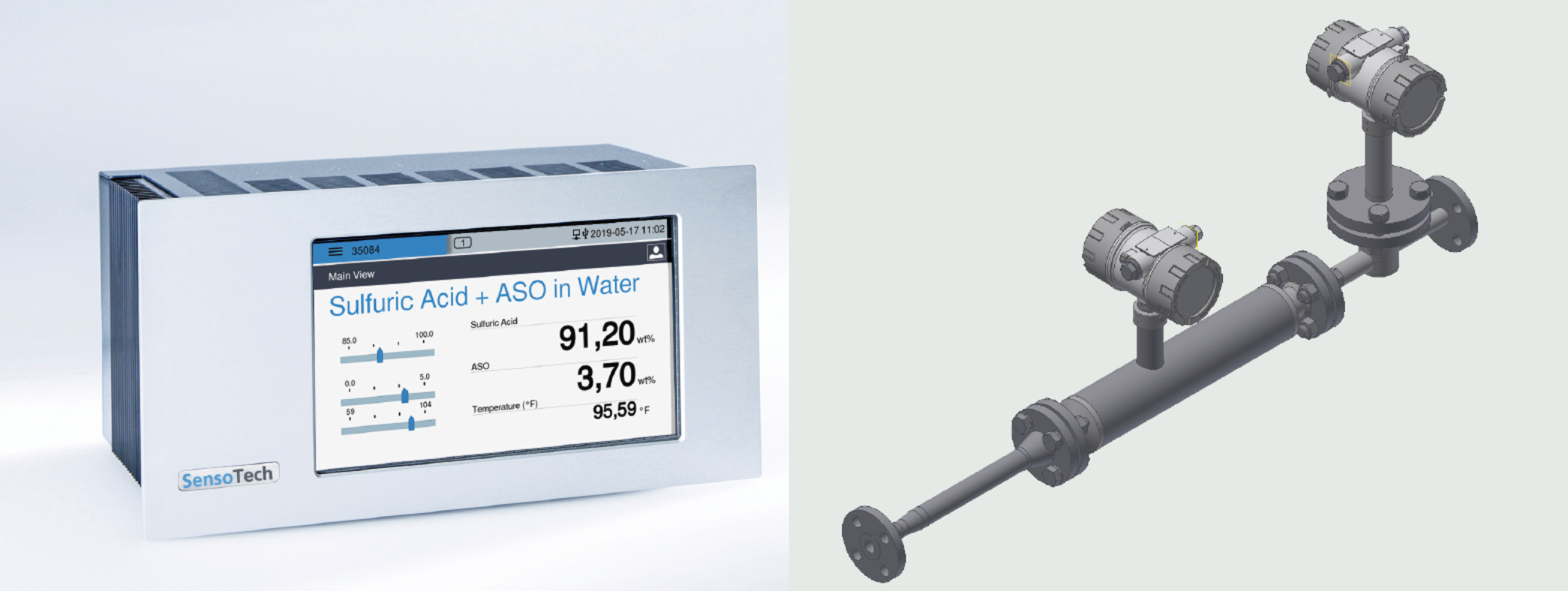
The LiquiSonic® Controller 40 is connected to the LiquiSonic® sonic velocity sensor and a density meter. The controller shows the concentration of acid and ASO in the main menu.
Typical measuring ranges:
Concentration H2SO4: 80 – 95 wt%
Concentration Water: 0 – 10 wt%
Concentration ASO: 0 – 10 wt%
Temperature: 10 – 30 °C
Customer value
The inline process control with the LiquiSonic® measuring device provides following advantages:
··
use of full plant capacity because of maintenance-free operation
··
stable process conditions and alkylate quality
··
corrosion protection because of inline determination of water content
··
evitation of fast acid consumption (acid runaway)
··
traceable monitoring with data record
··
increased plant safety because of minimized sample taking and lab analysis
Cost and time savings:
··
Reduced sample taking and laboratory costs:
··
Typically 4 hours or 400 Euros per day
··
Less acid losses: plant specific
··
Higher alkylate quality: plant specific
Investment: appr. 100.000 €
Amortization time: < 1 year
